Hunting Island, SC – Sunrise


 I. The Low Country

A few weeks back I went adventuring in South Carolina–in and around Edisto Island and other parts of the Low Country near Charleston. I was there to visit old friends, two guys I’ve known for nearly 25 years now but rarely see, but stumbled upon what I believe will eventually make a good piece of immersive, long form nonfiction. And I want to talk a little about it as the story develops.

One, who now lives in London, was visiting family; the other lives just northwest of Charleston along the Edisto River. The Low Country is beautiful–sandy soil, palmetto trees, and Spanish moss–and is a special place for me. Much of my mother’s family is from this area and has been for over three hundred years. I visited my grandparents near here. I also spent a memorable summer on a barrier island near Beaufort, SC (aka as Pat Conroy country), where I first met these two guys.

After our brief reunion, I intend to spend some time with one of the two on the cockfighting circuit. After what I’ve seen, I want to take a closer, objective look at this (blood) sport. Emphasis on objective for I don’t want to examine the ethics behind this mostly illegal sport but simply the subculture within America, particularly here in the Southeast. I will have to wait until the fall, for after June they don’t fight the birds again until September/October due to the excessive heat here.

II. The Good Doctor

MD (aka “The Good Doctor”) is older by ten years, though when we first met he was barely out of his twenties. But I was a dumbass of twenty, and he seemed like the wise old uncle who’d seen it all. In fact, he’s a country boy who grew up on a Low Country farm. He stands 6’6″ and has arms that swing like tree limbs, long and full of hardwood. As a young man, he boxed for awhile, making a name for himself as a bare knuckle boxer. I recall one whiskey-soaked evening in which we also heard a story about boxing a bear, but like all things from MD you have to take a step back. He’ll tell you anything, mostly because that’s what you want to hear.

MD picked me up at the Charleston airport and, after offering me a cold Corona from a cooler in the back, said we needed to stop by his farm, 500 acres of sandy soil, pine forest, corn fields, and a cock farm.

III. The Cock Farm 
I knew that MD had been into cockfighting for years, but didn’t know how serious he’d become as a “cocker” – that’s right, a cocker. I’d never seen him fight a gamecock and we’d had many sessions over beers in which we argued the ethics of what some call a blood sport. But the old man had gone pro and was now into raising champion cocks on his farm, hundreds of them spread over a couple of acres, blue barrels turned upside down with a tiny doorway cut into them (shade huts for the roosters) dotting the field like a plastic stonehenge and roosters strutting as far as their tethers would let them. And the sound–my god, hundreds of crowing cocks proclaiming their territory all at once, a symphony of five notes in a never-ending loop. A concert of noise that might either drive you mad or set you smiling at nature’s harmonies.
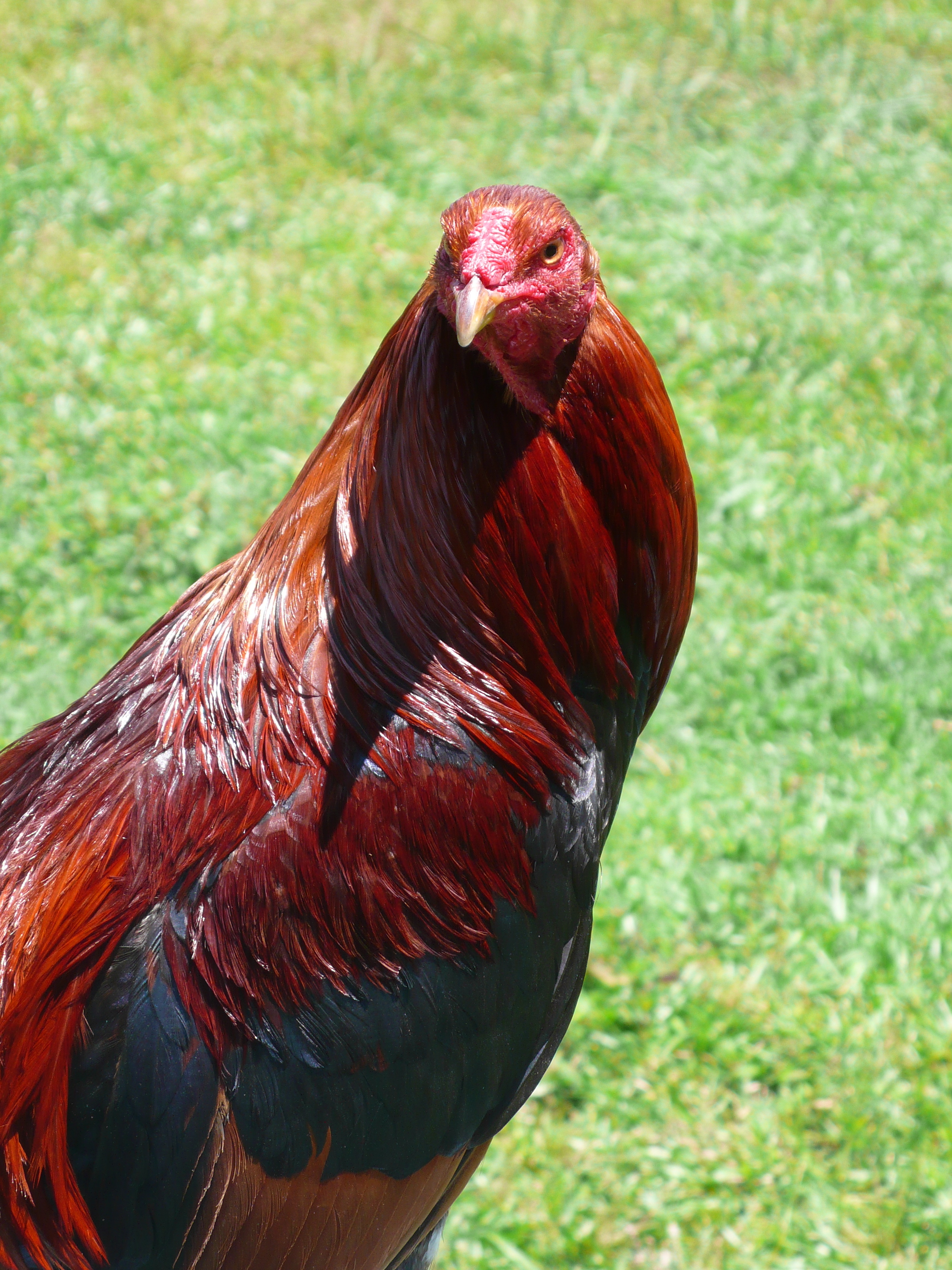
A Handsome
Cock

MD gave me a quick tour of the farm, roosters scurrying as we walked by. I’d never seen anything like it, birds everywhere, including hens and chicks in abundance. He scooped one of the roosters off of the ground and held it before me, a handsome bird whose feathers glistened in the sun. Because these are gamecocks, the comb and wattle (the red bits on top of their head and under their beaks) have been removed as they can be detrimental in a fight. I’m not an animal guy so arm’s length was as close as I wanted to get. He insisted I hold my arm out, palm up. Reluctantly, I did. He gently placed a mean-looking bird in my hand. And there it sat, beady, bird eyes blinking away, head bouncing in anticipation of whatever the hell roosters anticipate. Bird in hand, I reached up to stroke him, and realized MD had vanished.

Cockteaser at Rooster-Rama!

He’d gone to retrieve another gamecock. He wanted to demonstrate their instinct to fight each other. If you put two roosters before each other, he said, they will fight instinctively until the other is dead. For this little sparring match, he put on the boxing gloves, orange rubbers that go over their spurs, which the birds use to hurt each other. Even with the gloves, MD explained, they would beat on each other until one was dead. They know nothing else.

MD fitted the gamecocks with boxing gloves and dropped them to the ground together. They were at each other before their feet hit the grass. The feathers around their neck, called hackle, flared for a fight, great feathered coronas around their necks. The birds put up their feet as if wielding swords. They stabbed with their beaks.They jumped and flew at each other, driving feet and beaks first, each aiming to top the other.

Admission: it was riveting watching these two beautiful animals go at each other, so intent on harming the other bird. MD didn’t let the fight last long–again, they’ll kill each other if allowed, he told me. He returned them to their tiny plots of dirt and grass and blue barrel. Once out of sight, the birds relaxed and likely forgot all about the fight.

Other cultures, he said, where cockfighting is a significant and more-accepted part of the culture, such as the Philippines, Puerto Rico, Mexico, and Thailand, at al., augment their cocks with “blades”  they fasten to the rooster’s feet to insure a bloodier fight. In North America, this practice is generally frowned upon, he said, but showed me some of the blades from Mexico and the Philippines. 
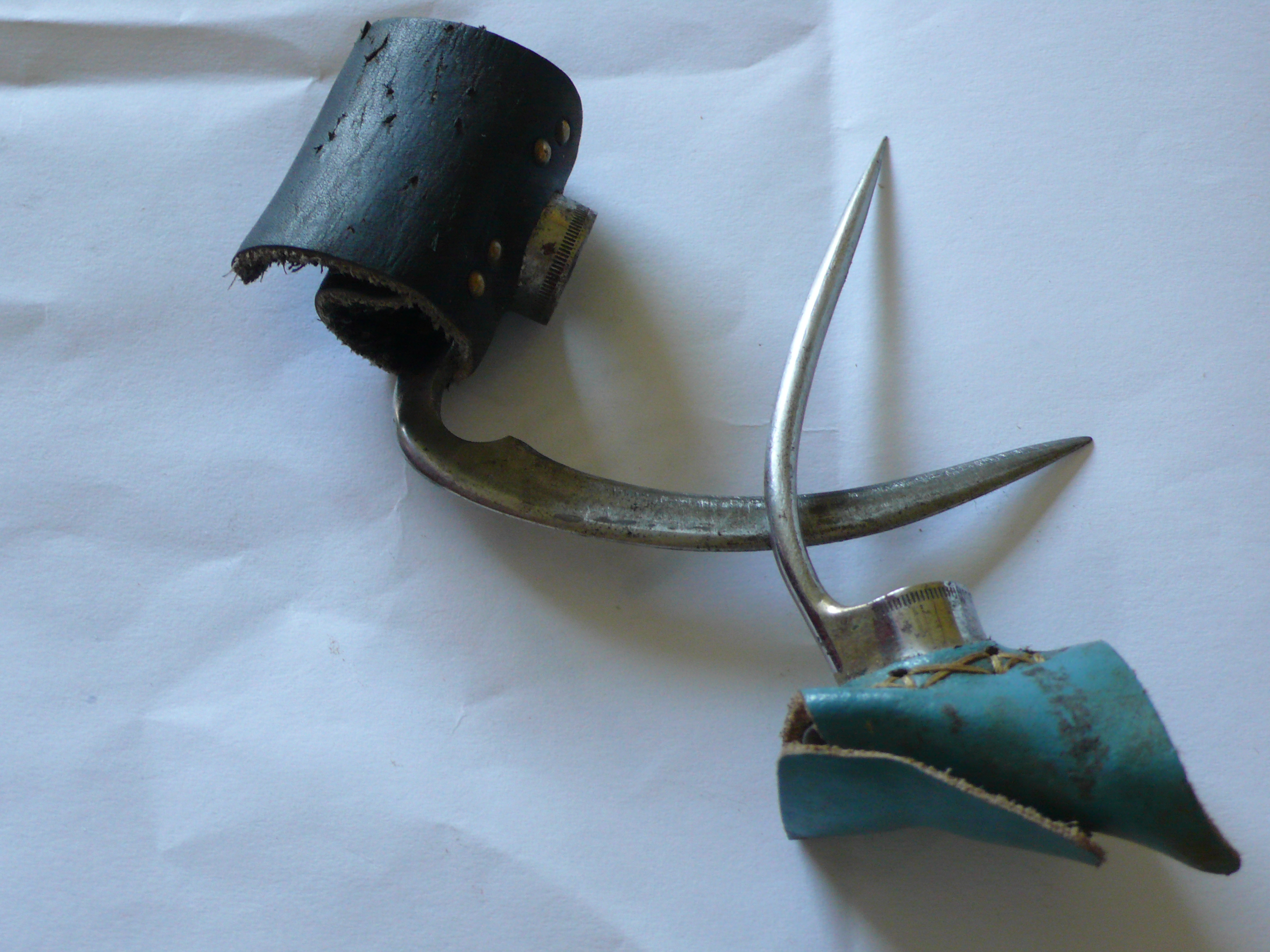
While I don’t entirely buy the rationale that cockfighting is natural–cockfights go until one is dead or gravel injured, after all, and for money (not much natural in that), it was an irresistible moment in which these beautiful creatures revealed the darker sides of animal nature, the instance heightened as over a hundred birds crowed their passion and swagger.
Next time: Here Comes the Rooster – Part II: The Silence of the Lambs

I talk about the short story at Atticus Books blog.

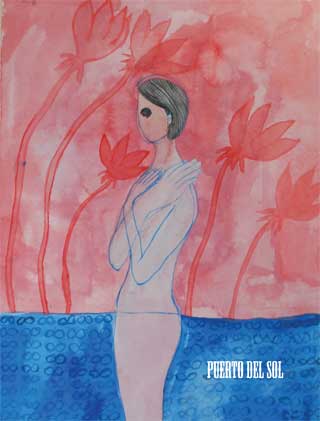
Puerto del Sol
Vol 47 – Summer 2012

Part I: The Gin and Tonic and Lime

My short story “A Very Wiggly Tooth” is out in the Summer 2012 issue of Puerto del Sol.

This story has had an unusual evolution. I began the story during a lull in the novel draft I have just finished (“For the Love of Mary Hooks”). I find it helpful (at least I did this one time) when a longer draft begins to sag in the middle and I need to kickstart the imagination, I work on shorter fiction or nonfiction. The novel demands such a long stretch of a single note that it’s difficult to hold that note through to the end without taking a breath. Working on shorter pieces feels like that necessary breath.

So it was that I took advantage of a break in the routine when my wife and daughter left me at home while they traveled and wrote a bunch of short fiction, among them the initial draft of “A Very Wiggly Tooth.” I had the key image for “Wiggly Tooth” in my head for some time–the gin and tonic and lime that opens the story.

“It happened when I was seven and losing teeth.

I tell you that because tonight I met a man who smelled of gin and tonic and lime. The smell of my father: the way I will always remember him. Even his last breaths were minted with that sweet cocktail of gin and tonic and lime as I lay over him trying to push air from own my lungs into his. In bars and restaurants, at parties, if I see a man drinking a gin and tonic from a highball glass or get a green whiff of juniper, I’ll go home with that man, if he asks, even if he doesn’t. There is no bitterness there, only pale-green memories of a man I adored.”

I’ve long wanted to tap into what I’ve learned as a father of a daughter–a unique relationship among parental relationships. Like most parents, I suspect, I worry about the million ways in which we fail our children. And by “we,” I mean I. But even the best of parents doesn’t always get it right, for whatever reasons. Yet, our children love us no less for our failures and faults. God help them, they just keep on loving us, forgiving us without even realizing they’re doing so. Ideally, that understanding–our recognition of our own failures and our children’s capacity for loving even the weakest of us–leads to being better parents, better people. In my own obsessive way, each night I recount in what ways I’ve failed my daughter that day. It’s almost always the small stuff–a preoccupation with the computer (“just five minutes, peanut, just one more email to send then…”), a need to sit and listen to the radio for a few minutes, a household or work-related problem to solve, etc. It all boils down to not spending time with her or not spending enough time with her. And that’s all she really wants from me–my time.

I wanted to write a story about a father who fails his daughter in much grander ways–as a dysfunctional, drunk oddball whose grief for his lost wife has proven insurmountable. But he loves his daughter and she loves him and they get by on what seems like that alone. The potential for a maudlin story, I hope, is undercut by the daughter’s strong, rambling voice and the father’s not always sympathetic behavior.

Originally, that potential was undercut by a zombie–that’s right, the father originally had returned as a zombie because he wanted to make sure his daughter was taken care and knew that he loved her, which she was all right with. I think I just really wanted to write a zombie story. I abandoned the zombie and just made him an oddball, but part of me still feels like this is a zombie story.

Part II: The Wiggly Tooth

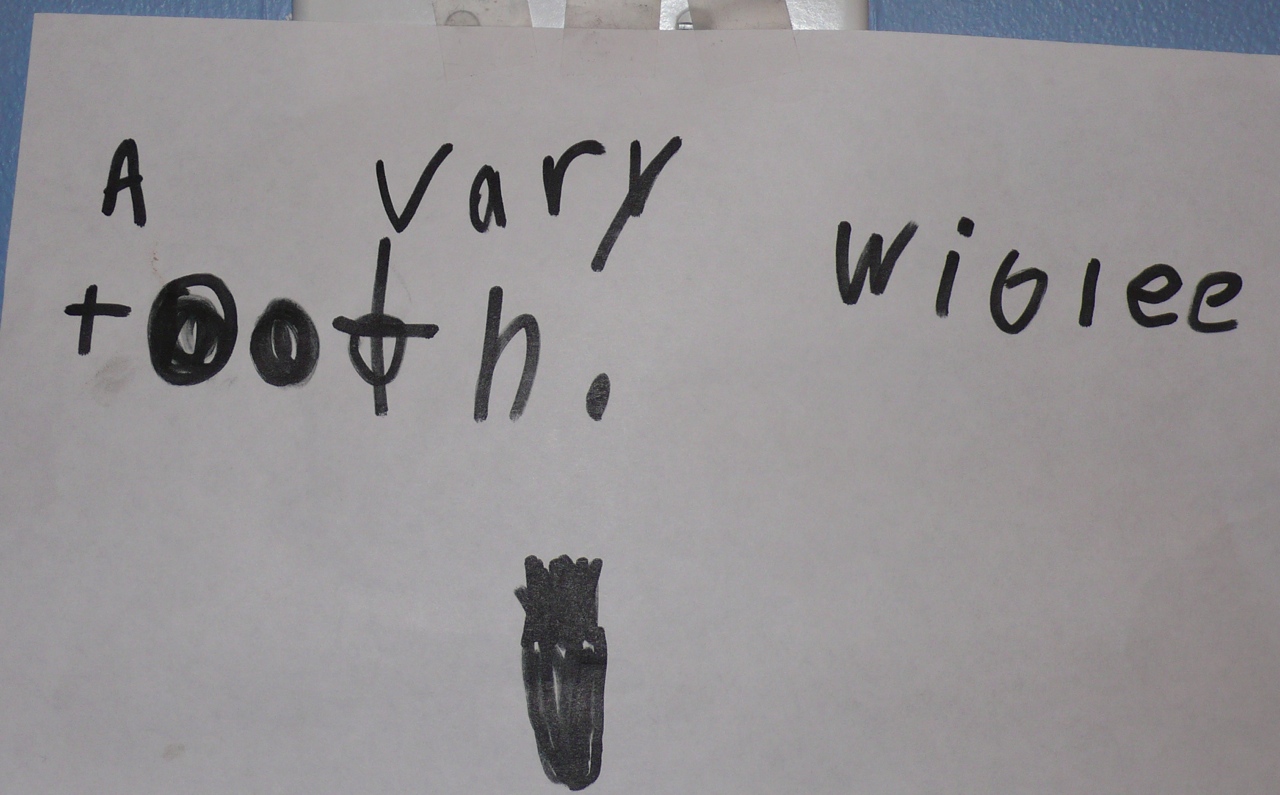
A Vary Wiglee Tooth
by HLB

The wiggly tooth has a different evolution–the photograph above. I took this photograph because I wanted to make sure I never lost the image. My daughter, the losing of her first tooth imminent, wanted to keep us updated on the status of the tooth. She posted this sign on the bathroom wall to let us know that the tooth was, indeed, “vary wiglee.” I liked the simple posting so much–misspellings, drawing and all–that I left it hanging for as long as it would stay stuck to the wall. Then I took the photograph.

And then the tooth wiggled its way into my story. And then and then and then…

The story employs a rambling (lots of long sentences), first-person narrator (the daughter) developing a non-linear story that often recoils on itself and runs off on tangent after tangent, spiderwebbing finally into a cohesive narrative. The wiggly tooth of the title was at first a red herring that never resurfaced after the first sentence. Later, after the zombie father was removed, it made its way back into the story.

The story and narrator are both unconventional and will probably drive any reader with a short attention span mad to the point of tossing the journal at a wall in frustration and disgust. For those with more patience, I am hopeful you will find what the editors of Puerto del Sol found–a story of a deeply flawed father and his loving daughter.

I sent the story to Puerto del Sol because they are a journal that often takes a chance on an unusual story, often publishing fiction that plays with form but still loves narrative. Thanks to the editors at Puerto del Sol for seeing what I hoped they’d see in this story. / CB

Next time on Animal Planet: I recall a serendipitous glimpse into the world of cockfighting and the wilds of nature after a weekend of adventuring in the South Carolina low-country.

I’ve been meaning to post about this smart collection of essays — Pulphead — from John Jeremiah Sullivan for some time but then I find and read another essay by him and would rather just read him than talk about him–I think I’ve finally exhausted what’s available out there. And now I’m in line behind dozens of other writers and readers who have already championed this guy’s work, someone whose prose is so intimate and immediate that I feel as if we have a relationship.

He writes in the tradition of the “new” journalists, a genre I love and don’t see nearly enough of, especially in the long form. Outside of Harper’s, The New Yorker, and occasionally pieces in GQ (where Sullivan has published many of his) Esquire, and some literary journals, few magazines publish long form journalism. A broad generalization: the contemporary reader has little patience for the 10,000+ word essay. For that matter, most readers can’t get past 800 words, an essay so short as to nearly negate the subject itself by so superficially exploring it (I exclude the compressed, or flash essay which explores a subject “through action, through objects, through metaphor, through inference (Brevity Craft Essays).”)

Sullivan uses long form journalism to explore just about any subject that catches his curiosity. And it’s his exhaustive curiosity, his ability and willingness to come at his subjects from the periphery while also investing himself in his subjects and his piece, that makes his work so goddamned compelling and addictive. Each essay is about much more than the title subject and he manages to make each one compelling. James Wood, writing in The New Yorker, says of Sullivan: “He seems to have in abundance the storyteller’s gifts: he is a fierce noticer, is undauntedly curious, is porous to gossip, and has a memory of childlike tenacity.”

To my writing students: I emphasize that an undaunted curiosity for the world–and not just the subjects we obsess over or that happen to be trending at the moment, but the world at-large–is essential. Never stop looking, wondering, asking questions.

John D’Agata–another favorite essayist–says that the essay is about “human wondering.” It’s this human wondering, this curiosity about the world and an attempt to explore it without the need for resolution, with the very real, even necessary possibility of failure, that makes for an interesting and successful writer. Scott Russell Sanders said: “The writing of an essay is like finding one’s way through a forest without being quite sure what game you are chasing, what landmark you are seeking.” And that kind of writing takes fearlessness and an insatiable desire to know more, more, more.

I also encourage students to read as much and as broadly as possible, a habit that should derive naturally from this need to know. I love this quote from Christopher Higgs in answer to the question “what should young writers today study or do in order to improve their craft?”

Become intellectually polyamorous, cultivate an insatiable curiosity for knowledge and experience in as many different guises as you possibly can, question everything, always challenge, learn that failure and rejection are positive things, subscribe to at least three non-literary magazines in three completely different fields (for me, right now, it’s National Geographic, Juxtapose, and Wine Enthusiast – last year it was Seed, Esquire, and Art in America), forget politics: it has nothing to do with you and any time or energy you invest in it is wasted time and energy you could be using productively to learn and experience and create, do not choose sides, do not agree or disagree, embrace contradiction, watch cinema from as many different countries and time periods as you possibly can, seek out unclassifiable music, spend time in unfamiliar locations, expose yourself to new activities, go to the opera, go to the ballet, go to the planetarium, travel a lot, observe as much as you can, pay attention to the way people talk and the way people listen, eat strange food, watch at least one sporting event but instead of thinking about it as entertainment think about it as narrative, ABR = Always Be Researching, carry a notebook and pen at all times, remember it is more important to ask questions than give or receive answers, seek to open up and never close down, seek to seek, do not seek to find, fall in love with language, think obsessively about language, about words, about sentences, about paragraphs, about the sound of words, the weight of words, the shape of words, the look of words, the feel of words, the placement of words, and most importantly be your biggest advocate, think of yourself as a genius, think of yourself as an artist, think of yourself as a creator, do not despair, do not listen to criticism, do not believe naysayers, they are wrong, you are right, they are death and you are life, they destroy and you create, the world needs what you have to say.

I live by this and remind my students daily. Read. Become readers. Become better readers. Read several new and different things daily–no excuses. The optimist in me remains hopeful.

Because I’ve run out of Sullivan essays to read, I picked up his first book: Blood Horses: Notes of a Sportswriter’s Son. It’s ostensibly about thoroughbreds, a subject I would not normally be drawn to–hell, horses, in general, for that matter. But to read broadly, you have to implicitly trust an author up front–which doesn’t always pay off–to make the chosen subject new, to find the strange in the familiar and the familiar in the strange. I’ve only just started Blood Horses but already I feel myself free-falling, curiouser and curiouser, the horse as fascinating a subject as any I’ve ever read.

Finally, check out john-jeremiah-sullivan-and-wells-tower-in-conversation at the New York Public Library (Tower’s Everything Ravaged, Everything Burned is one of the better short story collections in the past few years).

Atticus Review has compiled some of their favorite short fiction from the year into a single volume, which is available for a free download here. Anthology includes my short story “Deep Blue Sea,” and is yet another example of how AR is helping to change the landscape of what publishing can be.

Thanks to Katrina Gray – AR‘s Editor-in-Chief, and Dan Cafaro – founder and publisher of Atticus Books as well as the rest of the editorial staff.