Posts Tagged ‘writing’

BYARM_11

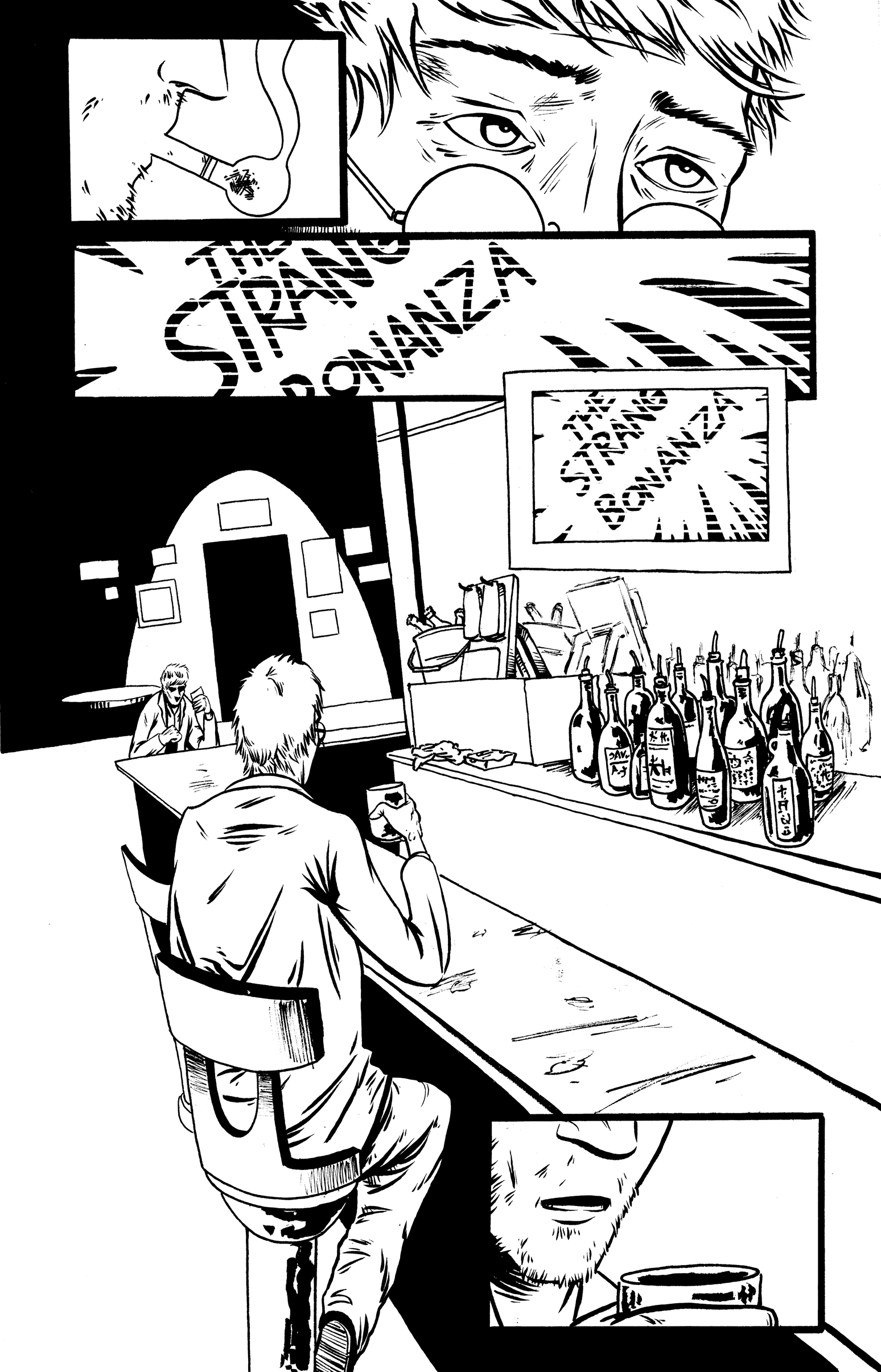
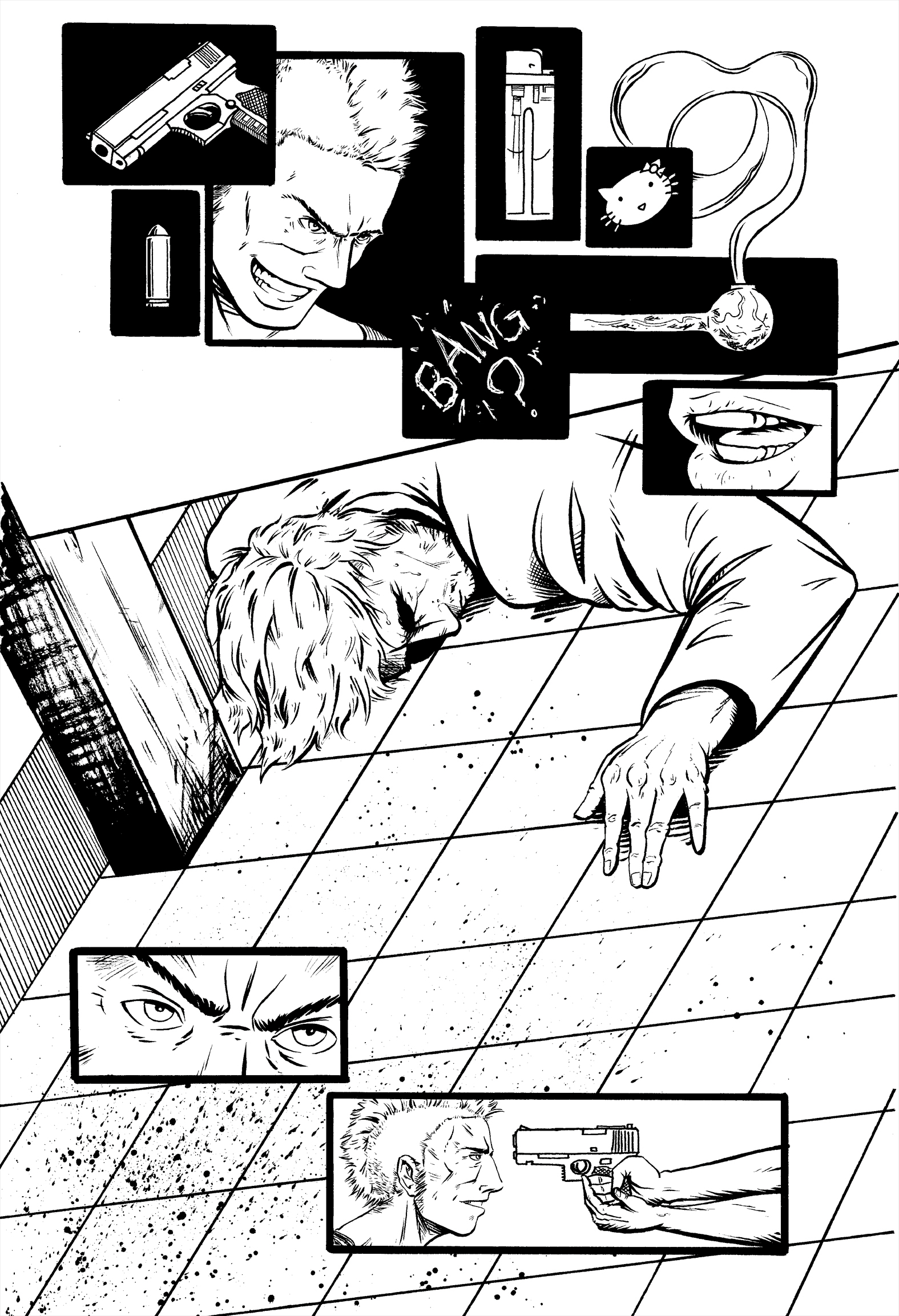
Illustration by Max Currie

The woman beside him was unremarkable save for layers of makeup over an acne scarred face and an amateurish attempt to dress Tokyo. The Japanese were fond of the expression: the nail that sticks up gets hammered down. Kent guessed this woman had been hammered back into place a few times. Her eyes were shadowed in amber, eyelids brushed with glitter. Her lips painted chocolate. Her hair straight and long, frosted with streaks of vanilla and brown, the tips rust colored. Platform shoes lifted her to five feet seven inches. She smoked menthols, lipstick staining the filter, a light chocolate frosting passed from mouth to cigarette and glass. The cigarette never left her fingers, a sixth digit on her hand, practiced at remaining in flight as she smoothed her hair down or dabbed at her mouth. She held her drink with the same hand, inhaling between sips of her Calpis and vodka, tapping her ashes to the floor. When she talked, she looked over Kent’s shoulder but never at him, as if ready for someone more promising to turn up in the Club Tamarindo.

Bullet

As the show’s host prepared to segue into a commercial, they reran another clip of The Strange Bonanza. On the television, a rail-thin goof in enormous black glasses screamed, RI-CHU-MAN-SAN! as Kent’s trademark loop played: a hip-hop mash-up highlighted with beatboxing and a chorus of soulful women singing: Baby, you’re a rich man! Kent didn’t remember just when he’d abandoned any sense of control over his career, but he guessed it might’ve been when that loop was created. TV Kent dropped his head, his Lennon glasses perched at the end of his narrow Roman nose, and smiled. The audience clapped and cheered on cue.

Bullet

Life Imitates Art: Boy, seven, kills brother while copying pro wrestling moves, the newspapers reported.

The doctors explained to Kent’s dazed parents that a direct blow to the chest directly over the heart at a particular time in the heart’s cycle can produce catastrophic consequences, something called commotio cordis, a form of ventricular fibrillation. The heart’s electrical activity becomes disordered and its lower chambers contract in a rapid, unsynchronized way, allowing little or no blood to be pumped. Collapse and sudden death can follow, which it did. Such cases are rare and always tragic, he told them, sorry he couldn’t do more. If only—

For weeks, seven-year-old Kent Richman, of Chapel Hill, North Carolina, had been famous, the story rippling across the country to cries of disgust, sparking debates about the effects of television violence on children. Kent was the example de jeur for Parents Against Violence on TV, who used his case in congressional hearings and in television ads, and even tried to coax his parents into joining them on nationwide tour to promote responsible television viewing. Kent had been big in America long before he was big in Japan.
Bullet

Ben Spivey, author of the recently released BLACK GOD (Blue Square Press, Nov 2012), tagged me in the ongoing “The Next Big Thing” interview series where authors answer a series of ten questions about their upcoming books and then tag other authors to do the same. Thanks, Ben…

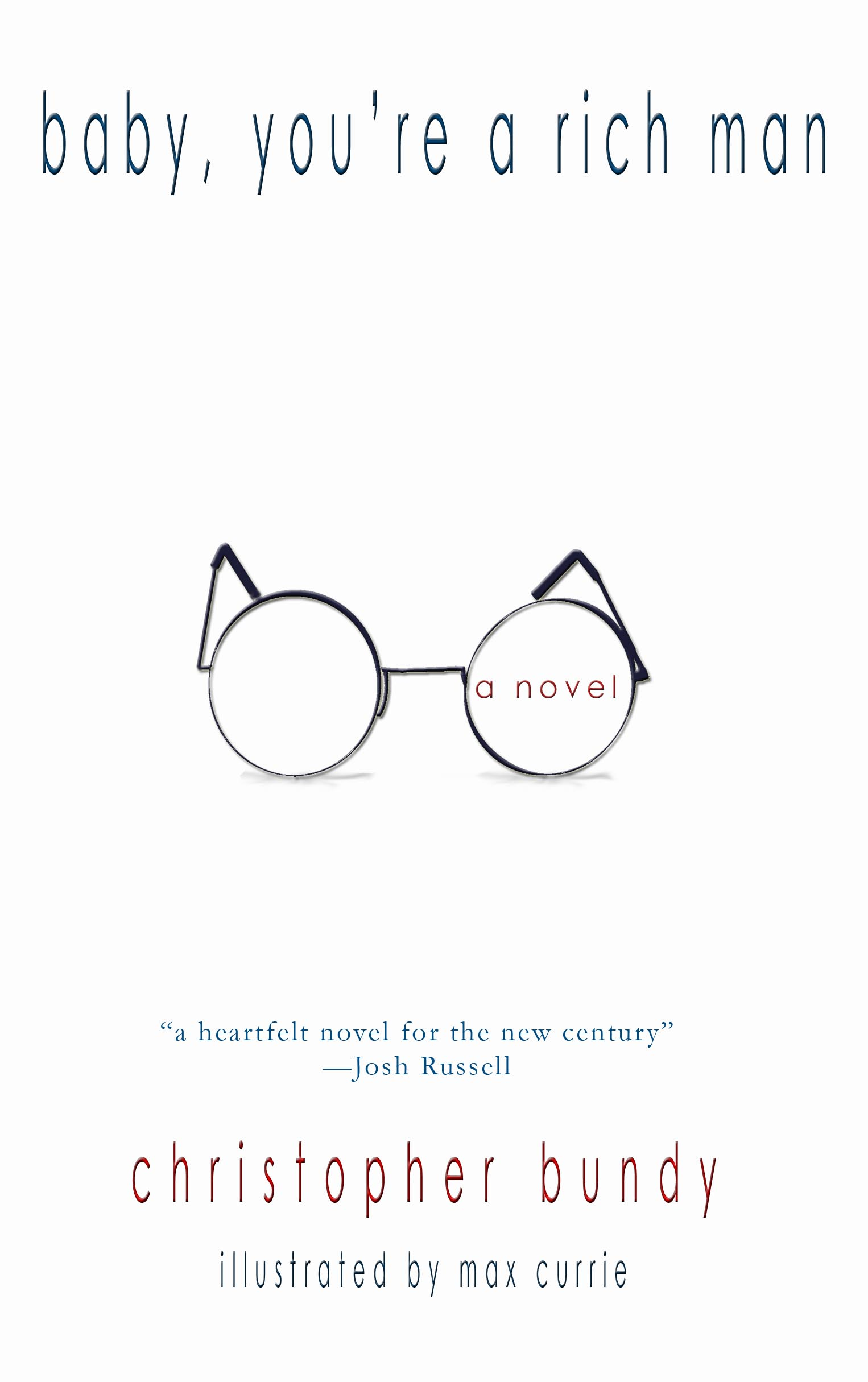
 Baby Youre a Rich Man Cover Front_final

1) What is the title of your latest book?

The novel BABY, YOU’RE A RICH MANdue Spring 2013.

2) Where did the idea come from for the book?

The idea for the book came from a short story I wrote called “Big in Japan” (Thuglit), which serves as the backstory for the novel. The idea for my protagonist Kent Richman, John Lennon look-a-like and B-level variety star on Japanese TV, came from watching Japanese TV when I lived there in the ‘90s. At that time, there were several foreigners who were popular on a number of variety shows.  Because guys like this spoke fluent Japanese and understood the culture inside/out, they were well-integrated into popular culture. I liked the idea of setting a story in Japan without resorting to the familiar “stranger in a strange land” scenario.

3) What genre does your book fall under?

Maybe contemporary satire via a noir-ish/Tarantino lens?

4) What actors would you choose to play the part of your characters in a movie rendition?

The protagonist has to look somewhat like a young John Lennon and be pretty skinny. Maybe Joseph Gordon-Levitt could pull it off. Or Christian Bale, if he could pass for twenty-something. Sean Lennon?

5) What is the one-sentence synopsis of your book?

Man has it all; man loses it all; man wants it back.

6) Who published your book?

C&R Press.

7) How long did it take you to write the first draft of the manuscript?

The first draft, and a much longer version with an entire sub-plot since excised from the novel, took about a year. Revisions took another year.

8) What other books would you compare this story to within your genre?

When I first started writing the book, I had read a lot of Haruki Murakami and loved that first-person narrative. It turned out to be neither in the first-person nor anything like his books, which is good. Books that might fall under the same category/style: Kingsley Amis’ Lucky Jim; Sam Lipsyte’s The Ask; Michael Chabon’s Wonder Boys, with a dash of William Gibson and Chuck Palahniuk.

9) Who or what inspired you to write this book?

In part, I felt a need to write a book about Japan because my time there meant so much to me. But I also wanted to do so in a way that wasn’t about Japan, i.e., I didn’t want to write about how weird or different Japanese culture might be perceived through a Western eye (stranger in a strange land), which has been done to death and feels more like travel essay. I felt the setting suited my protagonist’s story and went from there.

Also, many of my favorite stories revolve around man vs. himself, and I wanted to work from that premise.

10) What else about the book might pique the reader’s interest?

The book is also illustrated with black and white ink drawings from Max Currie, a friend and fantastic illustrator.

BYARM_19

Many were colored (see below) but are too expensive to print for a small press. I always thought the book should be illustrated because of the exaggerated nature of some parts of the story and the characters, like a good comic book. Kent’s life and Max’s illustrations mirror some of the gekiga (dramatic pictures) style of Japanese comics from masters like Yoshihiro Tatsumi whose underground comics reflected a darker reality and introduced the graphic novel format. And I like the way the illustrations reflect the combination of  grim realism and the absurdly comic in Kent’s story. Midway through the book, Kent even stumbles across a DIY comic book that someone has done, illustrating his post-celebrity life, which, of course, freaks him out. And there are also direct connections made in the book to the manga industry and the practice of cosplay (dressing up like comic book or anime characters), which is popular in Japan.

baby_illustrations_2

Finally, I think the book is funny, not ha-ha but subtly so. Kent Richman is one of those characters who straddles the line between sympathetic fuck-up and douchebag. My favorite kind, the ones who are learning how to live in the world. Kent means well, most of the time, but fails a lot. I’m hopeful the reader can see through the douchebaggery to the human.

You can pre-order BABY, YOU’RE A RICH MAN from the C&R Press site.

In the spirit of the series, I’m going to pass the mantle to Gabe Durham, author of the forthcoming FUN CAMP, from Mudluscious Press. He should be posting his own answers to the questions above soon. On to you, Gabe…

disney_tattooCheck out my short essay-“Happily-Ever-After Happens Every Day, or How I Learned to Love the Disney Sparkle” on the perils of a father struggling to absorb the Disney sparkle… at the excellent The Good Men Project

Ghost Stories

Posted: July 2, 2012 in Uncategorized
Tags: , , ,

Since I read and wrote about Chris Coake’s haunted You Came Back, it’s put me in the mood for a good ghost story. And it made me think of a few of my favorites. Kelly Link’s “Stone Animals” plays with the form/genre, i.e., it plays with the idea of what a “ghost” can be, much like Coake’s book. And I like that as much or more than outright transparent specters.

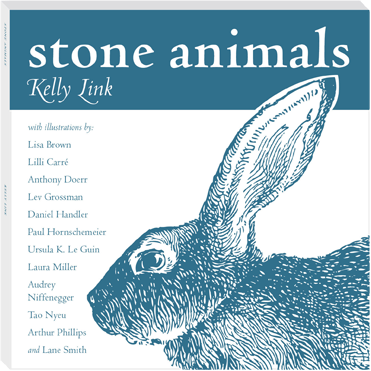
“Stone Animals” – Kelly Link – Check out this beautiful illustrated edition (with letterpressed cover) of Link’s story from Madras Press

“The Circular Valley” – Paul Bowles – In his collection A Distant Episode.

“Sea Oak” – George Saunders – In his collection Pastoralia.

These are only a few so I’ll probably add more as I remember them.

Just finished Christopher Coake‘s You Came Back – a book I didn’t want to read. There are almost no subjects I avoid reading about. If an author presents the material in a unique and compelling way, I can be curious about almost any subject. That is, unless it’s the loss of a child. As a father, this is the one subject you really never want to imagine, not through your own eyes, those of someone who’s lost a child, or those of a fictional character. Coake’s book is fiction but still I was wary.

I might not have picked up the book if I hadn’t already read Coake’s debut story collection – We’re in Trouble: Stories – and liked it so much. I’d also heard him read and met him when he interviewed for a position in the program where I was a graduate student. I liked him and his stories. And Coake knows a thing or two about grief, so I trusted him to treat the subject carefully.

I wasn’t disappointed. Using a very close third person, he planted me firmly in his protagonist’s shoes and, from the first pages, I was in for the duration. The story is driven by our compassion for the protagonist and his desire, like ours, to know, to understand what we don’t, including himself and his handling of his son’s tragic loss.

I grew up reading ghost stories (from Poe and Lovecraft to the wonderful (true) ghost stories of the Carolinas, particularly those set in the Outer Banks, to the ghost stories (the best of their work) of Stephen King and Peter Straub). I listened to the CBS Radio Mystery Theater on my transistor in bed at night (at 10:00 and long after I was supposed to be asleep) and, when I first tried to write, drafted my own (highly derivative) ghost stories. These stories stirred my imagination, left me both wondering at the possibilities and shrinking from them at the same time–always a skeptic. And Coake takes cues from this wonderful genre,but without exploiting it. His book is haunted, no question.

Coake works from real life and haunts his book with the emotional, spiritual and intellectual challenges there: loss, doubt, guilt, survival, faith/belief, and reconciliation. He employs a ghost story to get at these emotional issues in a compelling way.

I don’t want to say more. I read the book in two days and was glad for it. The book lingers in my (unsettled) heart and mind, and the more I think about it, the more I applaud what Coake has done so honestly–an unblinking look at the horrors of grief and survival.